 by
by Situated on Bahadur Shah Zafar Marg in New Delhi, the Arun Jaitley Stadium—formerly known as Feroz Shah Kotla—stands as India’s second-oldest international cricket venue, dating back to 1883. Operated by the Delhi & District Cricket Association (DDCA), it proudly serves as the home ground for the Delhi Capitals in the IPL and the Delhi Ranji Trophy team, continuing its legacy as a cornerstone of Indian cricket.
The stadium’s design and boundary layout have evolved through multiple renovations, most notably in 2019, when seating capacity was expanded to around 41,000 spectators and the playing area was modernized to meet ICC standards.
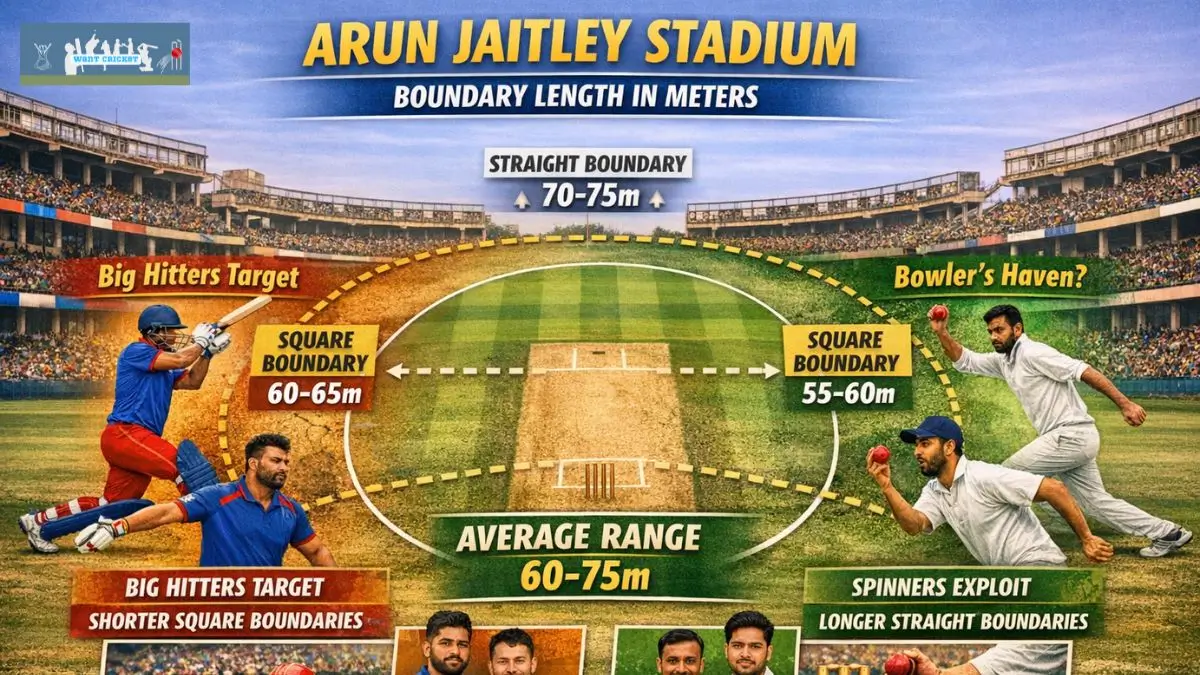
Boundary Length Details
| Match Format | Straight Boundary (m) | Square Boundary (m) | Average Boundary Range (m) |
|---|---|---|---|
| Test Matches | 70–75 | 65–70 | 70–75 |
| ODIs | 65–70 | 60–65 | 65–70 |
| T20s/IPL | 60–65 | 55–60 | 60–65 |
Key Insight:
- The shorter square boundaries make it easier for batters to clear the ropes, especially in T20s.
- The longer straight boundaries challenge power hitters and reward timing over brute force.
- The boundary ropes are occasionally adjusted inward for televised matches to enhance scoring potential.
Personal Experience
Having closely studied matches at the Arun Jaitley Stadium, I can attest that its boundary dimensions play a decisive role in shaping strategies. Aggressive batters such as Rishabh Pant and David Warner frequently exploit the shorter square boundaries to accelerate scoring, while crafty spinners like Axar Patel and Kuldeep Yadav cleverly utilize the longer straight boundaries to lure batters into risky aerial strokes.
The compact layout also amplifies crowd energy—every boundary feels closer, making the stadium one of the most electrifying venues during IPL nights.
Also Read: Arun Jaitley Cricket Stadium Delhi Pitch Report – Spin-Friendly Surface & Match Insights
Conclusion
The Arun Jaitley Stadium boundary length—ranging from 60 to 75 meters—creates a perfect balance between aggressive batting and tactical bowling. Its compact design ensures high-scoring encounters in T20s while maintaining traditional challenges in Tests.
Whether you’re a fan or a player, understanding the boundary dimensions at Delhi’s Arun Jaitley Stadium reveals why it remains one of India’s most dynamic and strategically rich cricket venues.