 by
by Team sports share a common thread — unity, strategy, and competition. Yet, cricket stands apart. Unlike football, basketball, or hockey, cricket is a sport where time stretches into days, roles are specialized to extremes, and the rhythm of play is dictated by patience as much as aggression.
As a cricket coach, I’ve often explained to newcomers that cricket is not just another team game. It is a blend of tradition, endurance, and tactical depth. This blog explores in detail how is cricket different from other team games, highlighting its unique rules, formats, and cultural significance.
Contents
Key Differences Between Cricket and Other Team Games
| Aspect | Cricket | Other Team Games |
|---|---|---|
| Duration | Matches last hours to 5 days | Usually 60–120 minutes |
| Roles | Specialized (batters, bowlers, wicketkeeper) | Players often interchangeable |
| Scoring | Runs accumulated over innings | Goals/points scored quickly |
| Field Size | Large oval ground | Rectangular, smaller fields |
| Equipment | Bat, ball, pads, gloves, helmet | Minimal gear (ball, stick, etc.) |
| Game Flow | Alternating batting and bowling | Continuous play |
| Result Possibilities | Win, loss, draw, tie | Mostly win or loss |
Unique Features of Cricket
1. Match Duration
Cricket’s formats range from 3‑hour T20s to 5‑day Test matches. This endurance sets it apart from sports like football or basketball, which conclude within two hours.
2. Specialized Roles
Unlike footballers who attack and defend interchangeably, cricketers specialize. Bowlers rarely bat well, and batters rarely bowl effectively. The wicketkeeper is a unique role absent in other sports.
3. Scoring System
Runs are accumulated ball by ball, over by over. A single six can electrify the crowd, but the slow grind of singles often wins matches. This contrasts with the quick scoring of goals or baskets.
4. Field and Equipment
Cricket grounds are vast ovals, with boundaries stretching 60–80 meters. Protective gear — pads, gloves, helmets — is essential, unlike minimal equipment in football or hockey.
5. Game Flow
Cricket alternates between batting and bowling innings. Only one team scores at a time, unlike continuous play in football or basketball.
6. Result Possibilities
Cricket allows for draws and ties, especially in Tests. This reflects its endurance and unpredictability.
Expert Insight
From my coaching experience, cricket teaches patience. In football, a goal can change everything in seconds. In cricket, a partnership built over hours can decide the match. This slow‑burn drama is what makes cricket unique.
I recall a Test match where our team defended for two sessions to secure a draw. That resilience, absent in most team sports, defines cricket’s character.
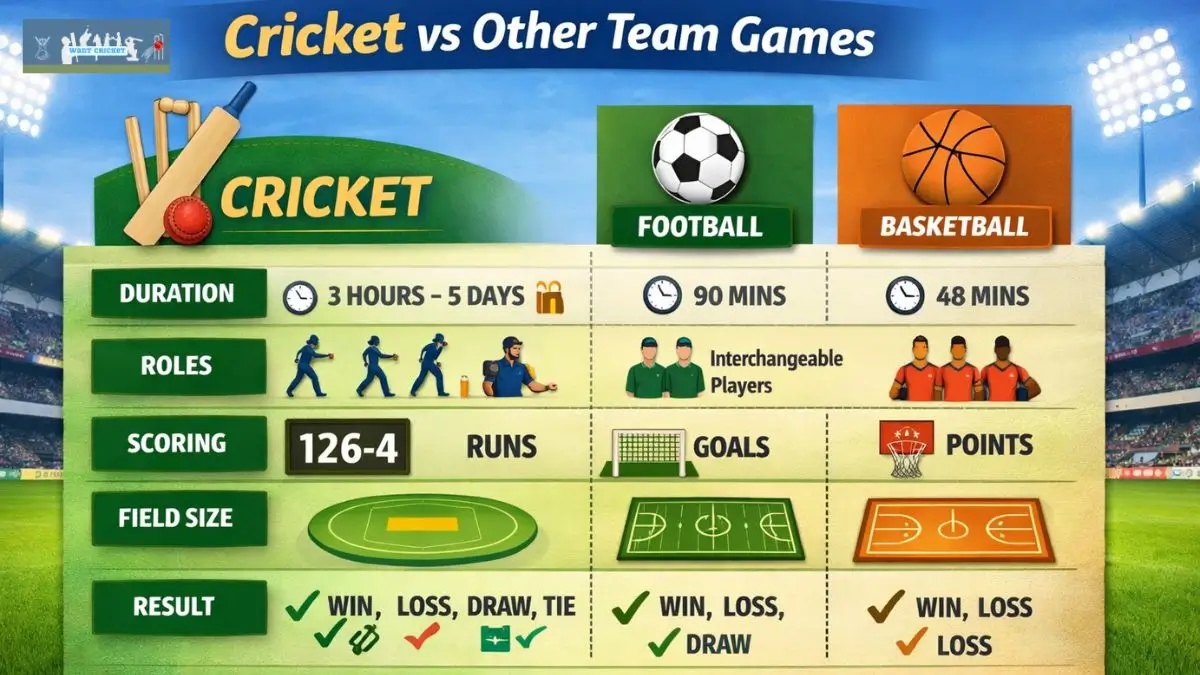
Cricket vs Football vs Basketball
| Aspect | Cricket | Football | Basketball |
|---|---|---|---|
| Duration | 3 hrs–5 days | 90 mins | 48 mins |
| Scoring | Runs | Goals | Points |
| Roles | Batters, bowlers, keeper | Attackers, defenders | Guards, forwards, centers |
| Field Size | Oval, 150–200m | Rectangular, 100m | Court, 28m |
| Result Types | Win, loss, draw, tie | Win, loss, draw | Win, loss |
Frequently Asked Questions (FAQs)
Que 1: Why does cricket last longer than other team games?
Ans: Because of its innings structure and emphasis on endurance.
Que 2: Can cricket end in a draw?
Ans: Yes, especially in Test matches.
Que 3: Why is the wicketkeeper unique?
Ans: They combine catching, stumping, and leadership roles absent in other sports.
Que 4: Is cricket more tactical than football?
Ans: Both are tactical, but cricket’s slower pace allows deeper strategic planning.
Also Read: Can Cricket Players Play Baseball? Skills, Challenges & Crossover Potential
Conclusion
Cricket is unlike any other team game. Its long duration, specialized roles, unique scoring, and cultural depth make it stand apart. While football and basketball thrive on speed and continuous play, cricket thrives on patience, precision, and tradition.
As a cricket expert, I believe these differences are what make cricket not just a sport, but a way of life. It is a game where time stretches, strategy deepens, and every run carries weight.