 by
by Cricket in India is not just a sport — it’s a cultural phenomenon that transcends caste, religion, and region. Yet, questions like “how many Brahmin players are in the Indian cricket team?” often surface in discussions about representation and diversity.
As a cricket coach and analyst, I’ve spent years observing how talent emerges from every corner of India — from dusty village grounds to elite academies. The truth is, cricket selection is based on performance, not caste. However, understanding the historical and social context behind this question helps us appreciate how far Indian cricket has come in breaking social barriers.
This blog explores the topic with depth, accuracy, and respect — tracing the evolution of representation, highlighting notable examples, and explaining why caste has little relevance in modern cricket selection.
Contents
- Understanding the Question
- Historical Context: From Elite Patronage to Meritocracy
- Notable Brahmin Cricketers in Indian History
- Modern Cricket: Caste Has No Role
- Case Studies: Talent Over Identity
- Representation and Diversity in Modern Teams
- Why Caste Discussions Miss the Point
- Frequently Asked Questions (FAQs)
- Conclusion: Cricket Unites, Not Divides
Understanding the Question
Before diving into numbers, it’s important to clarify what this question really means.
- Caste in Indian cricket is not officially recorded or considered in selection.
- BCCI and state associations select players purely on merit — runs, wickets, fitness, and form.
- Public records rarely mention caste, as it’s a private identity.
So, any discussion about “Brahmin players” must rely on historical context and publicly known backgrounds — not speculation.
Historical Context: From Elite Patronage to Meritocracy
In the early decades of Indian cricket (pre‑independence and early post‑independence), access to facilities and coaching was limited to urban elites. Many of these families happened to belong to upper‑caste backgrounds, including Brahmins, because they had education, leisure time, and financial means.
Key Phases of Evolution
| Era | Cricket Access | Social Composition |
|---|---|---|
| 1900–1947 | Club cricket under princely patronage | Urban elites, including Brahmins |
| 1947–1980 | Expansion through universities and railways | Middle‑class professionals |
| 1980–2000 | Rise of regional academies | Broader social mix |
| 2000–Present | IPL and grassroots scouting | Merit‑based, pan‑India diversity |
This shift from privilege to performance is one of Indian cricket’s greatest achievements.
Notable Brahmin Cricketers in Indian History
While caste is not a selection criterion, several players from Brahmin backgrounds have contributed immensely to Indian cricket. Their achievements are part of cricketing history, not social classification.
Prominent Examples (Historical and Modern)
| Player | Era | Role | Contribution |
|---|---|---|---|
| Sunil Gavaskar | 1970s–1980s | Opening Batter | Revolutionized Indian batting technique |
| Anil Kumble | 1990s–2000s | Leg‑spinner | India’s highest Test wicket‑taker |
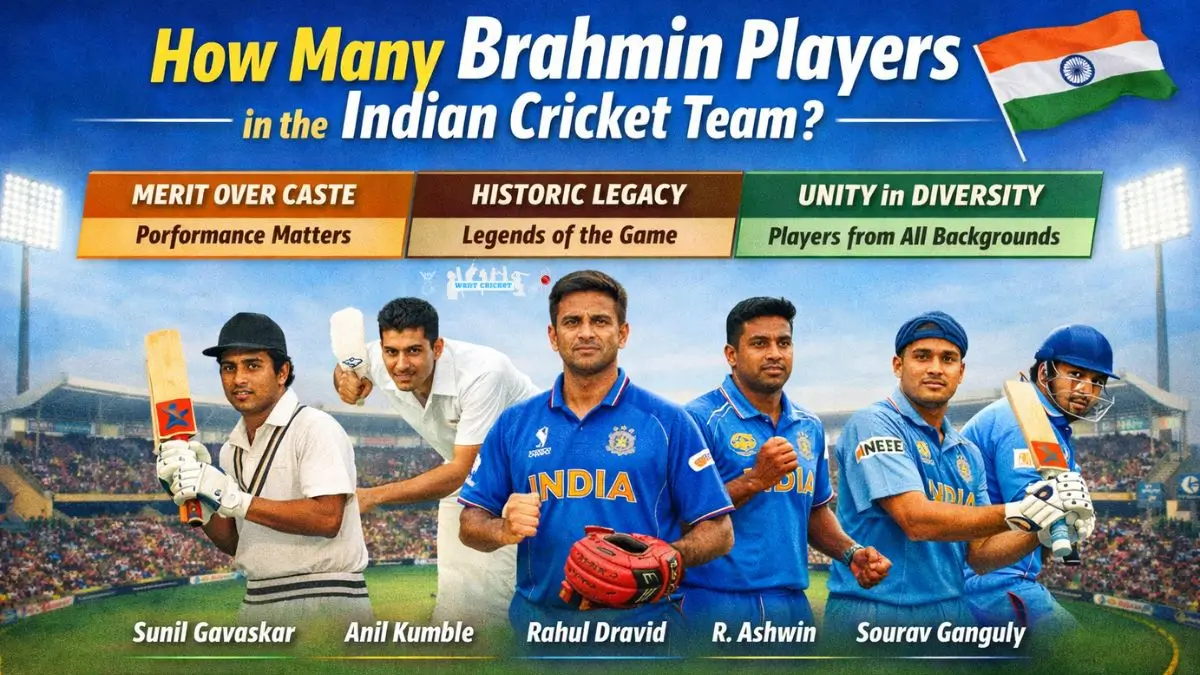
| Rahul Dravid | 1990s–2010s | Batter | “The Wall” — epitome of discipline |
| Sourav Ganguly | 1990s–2000s | Captain | Transformed India’s aggression abroad |
| Ravichandran Ashwin | 2010s–Present | Off‑spinner | Modern spin maestro and tactical genius |
| VVS Laxman | 1990s–2010s | Batter | Known for elegance and match‑saving innings |
| Murali Kartik | 2000s | Spinner | Consistent performer in domestic cricket |
| Sanjay Bangar | 2000s | All‑rounder | Later became India’s batting coach |
These names are mentioned purely for historical context — not to categorize or compare.
Modern Cricket: Caste Has No Role
Today’s Indian cricket ecosystem is built on performance metrics and data analytics. Selection committees evaluate players through domestic tournaments, fitness tests, and match impact — not social identity.
Selection Criteria in Modern Cricket
| Parameter | Description |
|---|---|
| Performance | Runs, wickets, strike rate, economy |
| Fitness | Yo‑Yo test, endurance, agility |
| Form | Recent domestic and international record |
| Team Balance | Role fit (opener, finisher, spinner, etc.) |
| Mental Strength | Handling pressure and adaptability |
This merit‑based system ensures that every talented player — regardless of background — has a fair chance.
Case Studies: Talent Over Identity
1. Ravichandran Ashwin — The Modern Thinker
Ashwin’s rise from Chennai’s streets to becoming India’s premier spinner shows how intellect and adaptability define success. His engineering background and analytical approach make him one of cricket’s most cerebral players.
2. Rahul Dravid — The Wall of Integrity
Dravid’s journey from Bangalore’s middle‑class upbringing to captaincy reflects discipline and education, not privilege. His leadership in nurturing young talent as coach continues that legacy.
3. Anil Kumble — The Warrior Scientist
Kumble’s methodical approach and resilience symbolize India’s transformation from grit to professionalism. His 10‑wicket haul against Pakistan remains legendary.
Representation and Diversity in Modern Teams
Indian cricket today is a mosaic of regions, languages, and communities.
| Region | Key Players | Cultural Mix |
|---|---|---|
| North India | Virat Kohli, Arshdeep Singh | Punjabi, Delhiite |
| South India | Ashwin, Jadeja, Samson | Tamil, Telugu, Malayali |
| West India | Rohit Sharma, Bumrah | Marathi, Gujarati |
| East India | Ishan Kishan, Rinku Singh | Bihari, Bengali |
This diversity reflects India’s social evolution — cricket has become a unifying force.
Why Caste Discussions Miss the Point
- Cricket is meritocratic. Runs and wickets decide careers, not surnames.
- Public records don’t list caste. Any count is speculative.
- Players represent India, not communities. The tricolor on their jersey transcends all divisions.
- Focusing on caste undermines achievement. It shifts attention from skill to identity.
Frequently Asked Questions (FAQs)
Que 1: Does BCCI record players’ caste?
Ans: No. The Board of Control for Cricket in India does not maintain or consider caste data.
Que 2: Are there Brahmin players in the current Indian team?
Ans: Yes, there are players from Brahmin backgrounds, but selection is based solely on merit.
Que 3: Has caste ever influenced selection?
Ans: Historically, access to facilities favored certain social groups, but modern cricket is merit‑driven.
Que 4: Why do people ask this question?
Ans: It stems from curiosity about representation and historical privilege, not from cricketing relevance.
Que 5: What matters most in selection today?
Ans: Performance, fitness, and mental toughness — not background.
Also Read: How To Become a Woman Cricketer in India – Step-by-Step Guide To Your Dream Career
Conclusion: Cricket Unites, Not Divides
The question “how many Brahmin players are in the Indian cricket team” may spark curiosity, but the real story lies in how cricket has evolved into a symbol of unity and meritocracy.
From Gavaskar’s technique to Ashwin’s intellect, from Kumble’s grit to Dravid’s discipline — these players represent excellence, not identity.
As a cricket expert, I’ve seen talent emerge from every social background. The pitch doesn’t ask your caste; it asks for your skill, patience, and courage. That’s the beauty of Indian cricket — a game where the only label that matters is Team India.