 by
by Sri Lanka is not just a country that plays cricket — it lives it. From the coastal breeze of Galle to the lush greenery of Kandy, every corner of the island echoes with the sound of leather meeting willow. As a cricket coach who has toured Sri Lanka, I can say that few nations match its passion for the game.
The question “how many cricket stadiums are in Sri Lanka?” opens a window into the country’s sporting soul. The answer isn’t just a number; it’s a story of heritage, architecture, and the evolution of cricket from colonial pastime to national pride.
Contents
- Overview: Stadium Count and Significance
- List of Major International Cricket Stadiums in Sri Lanka
- Why Sri Lanka’s Stadiums Are Unique
- Evolution of Stadium Infrastructure
- Coastal vs Inland Stadiums
- Stadiums That Hosted World Cup Matches
- Memorable Matches
- Domestic Cricket Grounds
- Frequently Asked Questions (FAQs)
- Conclusion
Overview: Stadium Count and Significance
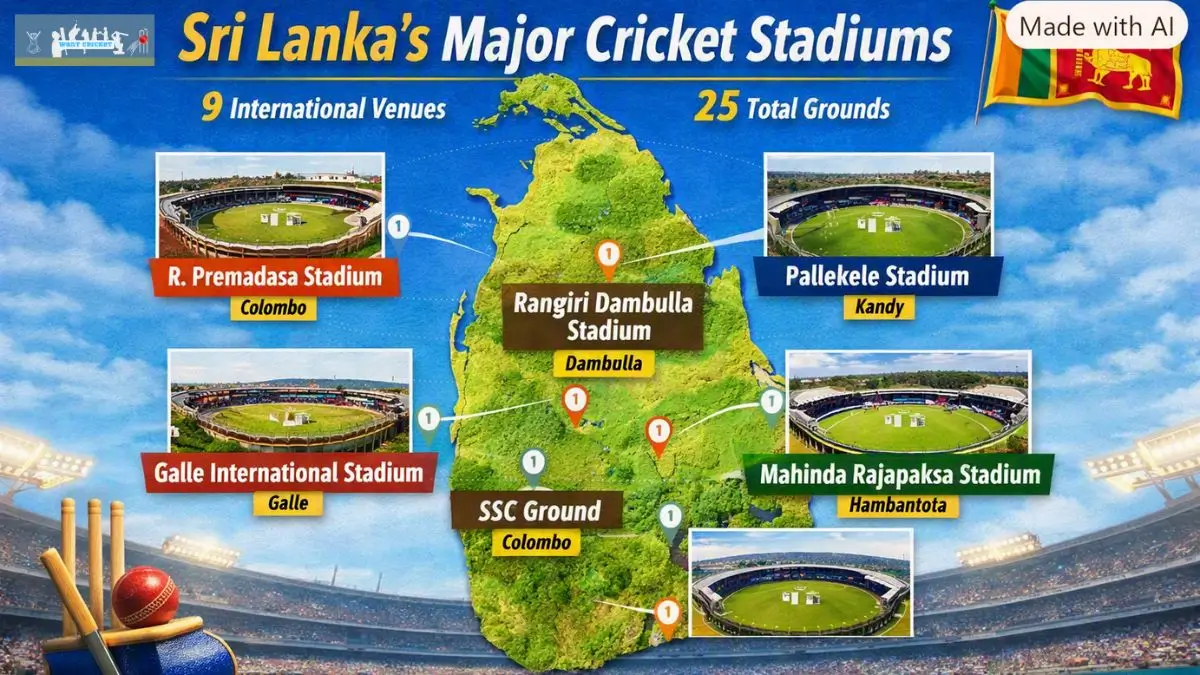
Sri Lanka currently has 25 recognized cricket grounds, of which 9 are international stadiums approved by the International Cricket Council (ICC) for hosting Tests, ODIs, and T20Is.
These stadiums are spread across major cities — Colombo, Kandy, Galle, Hambantota, Dambulla, and Pallekele — each with its own character and history.
List of Major International Cricket Stadiums in Sri Lanka
| Stadium Name | Location | Capacity | Established | Format Hosted |
|---|---|---|---|---|
| R. Premadasa Stadium | Colombo | 35,000 | 1986 | Test, ODI, T20I |
| Sinhalese Sports Club (SSC) | Colombo | 10,000 | 1899 | Test, ODI |
| Galle International Stadium | Galle | 18,000 | 1876 | Test, ODI |
| Pallekele International Cricket Stadium | Kandy | 35,000 | 2010 | Test, ODI, T20I |
| Mahinda Rajapaksa International Stadium | Hambantota | 35,000 | 2011 | ODI, T20I |
| Rangiri Dambulla International Stadium | Dambulla | 16,800 | 2001 | ODI, T20I |
| Asgiriya Stadium | Kandy | 10,000 | 1910 | Test |
| Tyronne Fernando Stadium | Moratuwa | 10,000 | 1979 | ODI |
| Colombo Cricket Club Ground | Colombo | 6,000 | 1869 | First‑class, occasional ODIs |
Why Sri Lanka’s Stadiums Are Unique
Each Sri Lankan stadium reflects the island’s geography and culture.
- Galle International Stadium sits beside the Indian Ocean, offering one of the most picturesque views in world cricket.
- Pallekele is nestled among hills, where mist rolls in during evening sessions.
- R. Premadasa in Colombo is the heartbeat of urban cricket — loud, passionate, and electric.
As a coach, I’ve seen how these venues influence playing styles. Spinners thrive in Galle’s dry conditions, while pacers enjoy bounce at Hambantota.
Evolution of Stadium Infrastructure
Sri Lanka’s stadium development mirrors its cricketing rise.
- Colonial Era (1800s–1940s): Cricket played in clubs like SSC and Colombo CC.
- Post‑Independence (1950s–1980s): Expansion of domestic grounds; Test status achieved in 1981.
- Modern Era (1990s–Present): ICC‑standard stadiums built for World Cups and bilateral series.
Coastal vs Inland Stadiums
| Type | Examples | Pitch Nature | Weather Impact |
|---|---|---|---|
| Coastal | Galle, Hambantota | Dry, spin‑friendly | High humidity, sea breeze |
| Inland | Pallekele, Dambulla | Balanced bounce | Cooler, occasional rain |
| Urban | Colombo (SSC, Premadasa) | Flat batting tracks | Hot, humid |
Stadiums That Hosted World Cup Matches
Sri Lanka co‑hosted the 1996 Cricket World Cup and 2011 World Cup, with matches played at:
- R. Premadasa Stadium
- Pallekele International Stadium
- Mahinda Rajapaksa Stadium
The 1996 semi‑final at Premadasa remains iconic — Sri Lanka’s victory over India marked a turning point in Asian cricket dominance.
Memorable Matches
1. Galle 2015 — Herath’s Magic
Rangana Herath’s 7‑for against Pakistan sealed a famous Test win, showcasing Galle’s spin paradise.
2. Pallekele 2011 — Sri Lanka vs Australia
A rain‑affected thriller where Sri Lanka defended 286 under lights — a testament to the stadium’s modern drainage system.
3. Premadasa 1996 — World Cup Semi‑Final
Crowds erupted as Sri Lanka reached their first World Cup final, rewriting cricket history.
Domestic Cricket Grounds
Beyond the international venues, Sri Lanka has 16 domestic stadiums used for first‑class and List‑A matches.
Notable examples:
- Bloomfield Cricket and Athletic Club Ground (Colombo)
- Nondescripts Cricket Club Ground (Colombo)
- Colts Cricket Club Ground (Colombo)
- Surrey Village Cricket Ground (Maggona)
- Welagedara Stadium (Kurunegala)
These grounds nurture young talent — the backbone of Sri Lanka’s cricketing pipeline.
Frequently Asked Questions (FAQs)
Que 1: How many international cricket stadiums are in Sri Lanka?
Ans: Nine stadiums are approved by ICC for international matches.
Que 2: Which is the oldest cricket stadium in Sri Lanka?
Ans: The Colombo Cricket Club Ground, established in 1869.
Que 3: Which stadium is the most scenic?
Ans: Galle International Stadium, located beside the Indian Ocean.
Que 4: Which stadium has the highest capacity?
Ans: R. Premadasa Stadium, Colombo — around 35,000 spectators.
Que 5: Which stadium hosts most ODIs?
Ans: R. Premadasa Stadium leads in ODI matches hosted.
Also Read: Which Cricketer Has Most Fake Followers on Instagram — How to Verify and Interpret Audits
Conclusion
Sri Lanka’s cricket stadiums are more than venues — they are living monuments to passion and perseverance. From the colonial charm of SSC to the modern grandeur of Hambantota, each ground tells a story of evolution and pride.
As a cricket expert, I’ve felt the pulse of these stadiums — the chants, the humidity, the artistry of spin. The answer to “how many cricket stadiums are in Sri Lanka” is not just nine international grounds, but countless dreams that rise from every pitch, every crowd, every victory.
Cricket in Sri Lanka isn’t confined to boundaries; it’s woven into the island’s identity — a game that unites, inspires, and endures.