 by
by Cricket has evolved from instinctive umpiring to data‑driven decision‑making. The Decision Review System (DRS) is the perfect example of how technology enhances fairness. It’s not just about overturning decisions — it’s about understanding how science, angles, and timing come together to determine truth on the field.
As a cricket coach, I’ve seen players rely on DRS not just for appeals but for confidence. Knowing how DRS is calculated helps fans appreciate the complexity behind every “Umpire’s Call.” This blog explains in detail how to calculate DRS in cricket, breaking down each component — ball tracking, UltraEdge, Hot Spot, and the decision process — with examples and expert insight.
Contents
What Is DRS in Cricket?
The Decision Review System (DRS) is a technology‑based process that allows players to challenge an on‑field umpire’s decision. It combines multiple tools to analyze the incident and determine whether the original decision should stand or be overturned.
Core Components:
- Ball Tracking (Hawk‑Eye)
- UltraEdge / Snickometer
- Hot Spot (Infrared Imaging)
- Slow‑Motion Replay
- Umpire’s Call Protocol
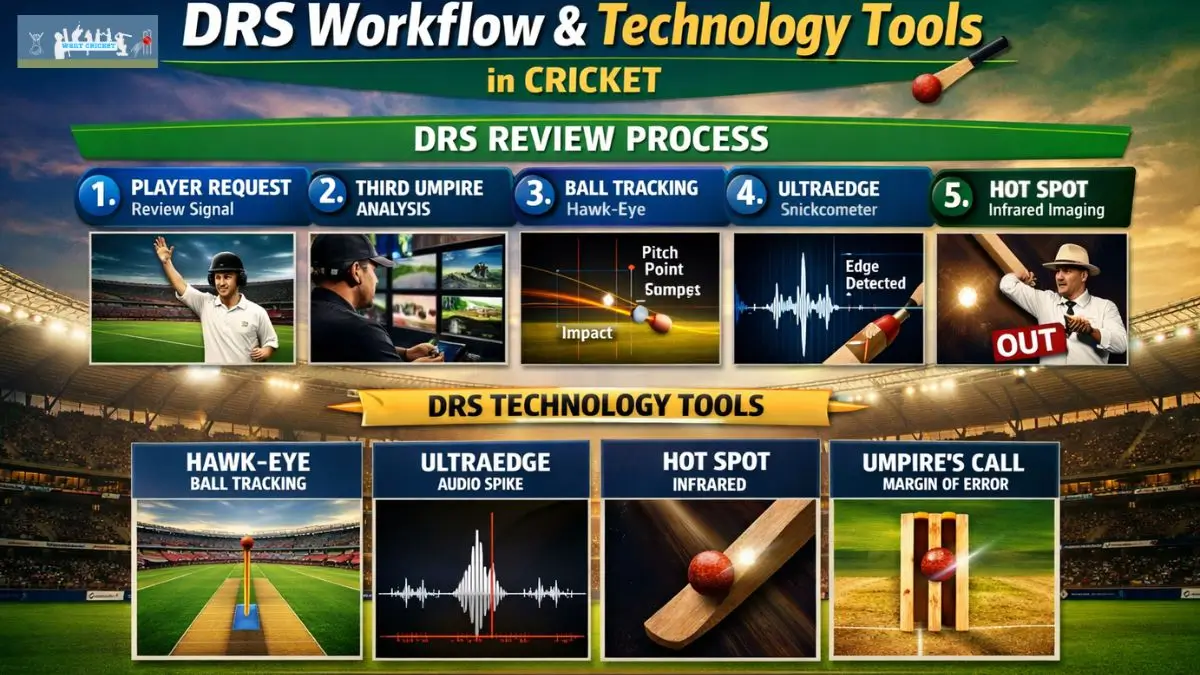
Step‑by‑Step: How DRS Is Calculated
1. Player Review Initiation
A player (usually the captain or batter) signals for a review within 15 seconds of the umpire’s decision.
2. Third Umpire Analysis
The third umpire uses technology to analyze the incident.
3. Ball Tracking (Hawk‑Eye)

This system predicts the ball’s trajectory after impact. It calculates:
If the ball is shown to hit the stumps, the decision may be overturned.
4. UltraEdge / Snickometer
Sound waves are analyzed to detect faint edges. A spike on the graph during ball proximity to the bat indicates contact.
5. Hot Spot
Infrared cameras detect heat generated by friction between ball and bat/pad. A white mark confirms contact.
6. Final Decision
The third umpire combines all data and communicates the result to the on‑field umpire.
DRS Calculation Example
Scenario:
- Ball pitches in line.
- Impact in line.
- Ball projected to hit middle stump.
Result: OUT (LBW).
If the ball’s impact is outside off and the batter is playing a shot, the result becomes NOT OUT.
DRS Tools and Their Functions
| Tool | Purpose | Technology Used | Example |
|---|---|---|---|
| Hawk‑Eye | Predicts ball trajectory | 6 high‑speed cameras | LBW decisions |
| UltraEdge | Detects faint edges | Sound wave analysis | Caught behind |
| Hot Spot | Shows contact points | Infrared imaging | Bat‑pad contact |
| Replay System | Confirms run‑outs/stumpings | Frame‑by‑frame video | Close calls |
| Umpire’s Call | Retains partial umpire authority | Margin of error | Ball clipping stumps |
Expert Insight
From my coaching experience, DRS has changed how players approach appeals. Bowlers are more confident knowing technology can validate their accuracy, while batters feel protected against marginal errors.
During a domestic match in Raipur, our bowler appealed for LBW. The on‑field umpire gave it not out, but DRS showed the ball clipping leg stump — Umpire’s Call. That moment taught my players the importance of precision in line and length.
Understanding “Umpire’s Call”
This is the most debated part of DRS. It applies when the ball is marginally hitting the stumps.
Rules:
- If less than 50% of the ball hits the stumps → Umpire’s Call stands.
- If more than 50% hits → Decision overturned.
Purpose: To respect the on‑field umpire’s judgment while acknowledging technology’s margin of error.
Frequently Asked Questions (FAQs)
Que 1: What does DRS stand for?
Ans: Decision Review System.
Que 2: How many reviews are allowed per innings?
Ans: Tests – 2 per innings (per team); ODIs & T20s – 1 per innings.
Que 3: Can DRS overturn an umpire’s call?
Ans: Yes, if technology shows conclusive evidence.
Que 4: Who decides the final outcome?
Ans: The third umpire, after analyzing all technological inputs.
Que 5: Is DRS always accurate?
Ans: It’s highly reliable but allows a margin for human and technical error.
Conclusion
The Decision Review System is not just technology — it’s the bridge between human judgment and scientific precision. Understanding how DRS is calculated reveals the depth of cricket’s evolution.
As a cricket expert, I see DRS as a learning tool. It teaches players accountability, fans transparency, and umpires consistency. Every review is a reminder that cricket, at its core, values fairness above all.